
Things are Getting Worse, but We Can’t Let that Stop Us

The U.S.—the country of my birth and current residence—has an abysmal history of genocide, enslavement, dispossession, and injustice, only intermittently relieved by contributions to humanity that are nonetheless real and highly significant. It is a nation of profound aspiration and profound brutality, capable of both democratic invention and systematic betrayal.

Given its reputation as a bastion of democracy, among its more egregious actions during my lifetime are its overt and covert efforts to undermine democracy elsewhere. The contradiction is not incidental. It is structural. Again and again, American leaders have proclaimed freedom while supporting repression, invoked order while sowing chaos, and justified domination in the name of stability, security, or progress.

“The political scientist Lindsey O’Rourke has counted sixty-four occasions when the U.S. sought to secretly oust a government or tilt an election during the Cold War,” writes Daniel Immerwahr in The New Yorker (March 23, 2026). “More than two-thirds of these attempts were, like the Iran coup, in support of authoritarians.” Many similar efforts, both during the Cold War and since, have not been secret at all. Nor have they been coherent or principled. From U.S. involvement in the overthrow of Salvador Allende in Chile to the removal of Saddam Hussein in Iraq, they have often been opportunistic, short-sighted, and catastrophic in their human consequences.

The deeper problem is not only hypocrisy, though there has been plenty of that. It is the habit of presuming that immense power confers wisdom; that military, financial, and technological dominance entitle one nation to shape the destiny of others; that history can be managed from above without moral injury or systemic blowback. This illusion has cost countless lives. It has also degraded the moral and civic fabric of the United States itself.

I despair of my country enough that I have largely abandoned sustained attention to U.S. politics and policy. Not because they do not matter, but because the planetary predicament seems to me vastly more consequential in the long run than whatever transpires during the remaining years of the second Trump administration—or what comes after it. Empires rise and decline. Administrations come and go. But the integrity of the biosphere, the stability of the climate, the viability of civilization, and the possibility of a habitable future are questions on an altogether different scale.

All I can say, at this point, is that I hope to contribute to one of America’s better innovations on behalf of humanity: the capacity to imagine beyond inherited limits, to create new forms, to experiment, to organize, to renew. We need to turn our attention away from the compulsive day-to-day preoccupations of our society and toward the needs of humanity’s future. We need, all of us, to step back and take a longer view of history.

Do I wish we lived in better times? Of course. But what matters most is not merely the spectacle of our fractured and fractious society. What matters is how you and I are spending our time, what we are giving our lives to, and what we are choosing to serve. Denouncing the daily outrages being perpetrated on the body politic, however justified and however satisfying, can easily become a trap: a way of surrendering our deepest agency to the very forces we oppose. Necessary witness has its place. But witness alone is not enough. We are already called to the greater work of crafting a new world.

What matters is to continue moving forward with this project in both good times and bad. In fact, it may be even more important in bad times, because it keeps alive the light of possibility, intelligence, and wisdom. Healing Gaia and healing ourselves in the midst of societal breakdown. Keeping alive the hope of civility, truthfulness, and mutual care. Guiding technological development toward greater human and more-than-human well-being. Protecting the conditions under which future generations may yet flourish.

This is not withdrawal. It is not quietism. It is a refusal to let the terms of a degraded politics define the horizon of human possibility. It is a decision to align oneself with what is larger, longer, and more enduring than the current disorder: with life, with regeneration, with the unfinished work of becoming a wiser species.

I lament my country and the role it is currently playing on the world stage. But I cannot let this stop me from contributing to a better future. Nor should it stop you.

The Chilling Effect of Trump’s Climate Actions on the Climate Community

The non-governmental organizations and institutions dedicated to climate mitigation and adaptation have long been the backbone of efforts to curb greenhouse gas emissions, develop sustainable technologies, and build resilient communities. However, the chilling effect of Donald Trump’s climate policies has cast a shadow over this critical work, obstructing progress at a time when urgent action is needed more than ever.

Trump’s systematic dismantling of climate policies—ranging from withdrawing the U.S. from the Paris Agreement to rolling back emissions standards and cutting climate research funding—has created a hostile environment for those working in climate science, renewable energy, and environmental advocacy. With government leadership retreating, NGOs and private organizations face increased challenges in securing funding, influencing policy, and mobilizing public support for meaningful climate action.

Yet reducing global greenhouse gas emissions remains urgent. By reversing its climate policies, the U.S. is not only losing valuable time but actively accelerating the depletion of its remaining carbon budget. As climate models have long predicted, predictable climate-related disasters—wildfires, hurricanes, droughts, and sea-level rise—are arriving sooner and with greater intensity.

Continue reading “The Chilling Effect of Trump’s Climate Actions on the Climate Community”

Avoiding the Worst Consequences of Collapse

It’s important to take a moment in the midst of the current political turmoil to consider what‘s really at stake. What we’re seeing from the Trump White House may be a symptom of the breakdown occurring as the new Administration tries to turn back the clock in several critical areas—climate, equity, foreign aid, and public service—while pursuing global triumphalism. But the consequences of a world economy built on fossil fuels, mass consumerism, and conventional agriculture are unavoidable. We need to understand that we are in the midst of collapse, and that chaos and conflict will only accelerate it. Here’s what even ChatGPT recognizes to be the situation we face.

The Reality of Accelerating Collapse

Civilization as we know it is under immense strain. Climate change, biodiversity loss, desertification, and ocean acidification are just some of the existential crises unfolding at an accelerating pace. These environmental pressures are compounded by political instability, economic fragility, and disruptive social movements seeking to overturn the status quo. We are in the midst of what scientists and historians may come to call the most decisive decade of the 21st century. What we do—or fail to do—will determine whether the future remains habitable for humanity and countless other species Continue reading “Avoiding the Worst Consequences of Collapse”

Ignoring the True Cost of Carbon Emissions

President Trump’s recent Executive Order (EO), titled “Unleashing American Energy,” signals a significant shift in U.S. energy policy. While the EO aims to boost domestic energy production and reduce regulatory burdens, it notably targets the concept of the social cost of carbon (SCC), calling it “logically deficient,” “poorly based in empirical science,” “politicized,” and “absent of a foundation in legislation”. This move has profound implications for our understanding of climate change and how we address it.

What is the Social Cost of Carbon?

The SCC is an economic estimate, measured in dollars, of the long-term damage caused by emitting one additional ton of carbon dioxide (CO2) into the atmosphere. It encompasses a wide range of impacts, such as:

  • Rising sea levels
  • More frequent and severe weather events
  • Reduced agricultural productivity
  • Negative health impacts

By assigning a monetary value to these harms, the SCC allows policymakers to weigh the costs of carbon emissions against the benefits of policies that reduce them. For example, if reducing emissions costs less than the SCC, then the action is economically justified. The SCC is also used to evaluate the benefits of reducing other greenhouse gasses, such as methane and nitrous oxide. Estimates of the SCC increase over time because future emissions are expected to produce larger damages as physical and economic systems become more stressed.

Why is the Social Cost of Carbon Important?

The SCC is essential for making informed decisions about energy production, infrastructure, and climate adaptation. It helps to justify investments in renewable energy and other measures that reduce greenhouse gas emissions. It provides a way to evaluate the trade-offs between short-term economic gains and long-term climate costs. Without this valuation, the true cost of carbon emissions remains hidden. Continue reading “Ignoring the True Cost of Carbon Emissions”

New C-PACE Bill Passes in New Jersey

After almost ten years of concerted advocacy, New Jersey’s C-PACE law is finally being amended to make it actually usable by municipalities and commercial property owners to limit their carbon emissions, save money, and create new jobs and opportunities in local communities. While it will still be a number of months before the NJ Economic Development Authority (NJEDA) issues rules and guidelines, the passage of the new bill (A2374/S1953) is a major milestone in NJ’s commitment to meaningful climate action.

Here’s the press release posted by New Jersey PACE and its affiliated sites yesterday:

The Commercial Property Assessed Clean Energy program, already approved in 37 states and D.C., with active programs in 24 states, is headed to the Governor’s desk for signature

Trenton, N.J. — On June 24 the New Jersey Legislature approved A2374/S1953 with overwhelming, bipartisan majorities in both the Assembly and Senate. The C-PACE (Commercial Property Assessed Clean Energy) bill establishes the Garden State C-PACE Program, to be developed and overseen by the New Jersey Economic Development Authority (NJEDA).

The bill was sponsored by Assemblyman Raj Mukherji (D-Jersey City) and Senators Bob Smith (D-Piscataway) and Kip Bateman (R-Somerset).  This represents the culmination of a ten-year effort by New Jersey PACE (NJPACE), a 501c3 nonprofit organization, to amend NJ’s unworkable 2011 PACE (Property Assessed Clean Energy) statute.

The legislation establishes a program that, through a municipal ordinance, allows commercial property owners to privately finance energy efficiency, renewables, and resiliency projects and repay them over time through a special assessment on the property tax bill, similar to a sidewalk or sewer assessment. These projects are 100% financed with private sector capital—no taxpayer or public monies are used.

Continue reading “New C-PACE Bill Passes in New Jersey”

New Stormwater Fees the Perfect Opportunity for PACE

[Reposted from NewJerseyPACE.org]

Combined Sewer Overflow — Jersey Water Works

February 14, 2019: NJ’s new stormwater utility bill (A2694/S1073) authorizes municipalities to collect fees on parking lots and other impervious surfaces to fund improvements to failing stormwater systems. But it has many commercial property owners concerned that they will now face significant new charges on their property. If the legislature and the Murphy Administration want to address these concerns in a meaningful way, PACE (Property Assessed Clean Energy) is the obvious answer.

PACE can provide 100% long-term financing for projects designed to reduce stormwater runoff by building retention systems, green roofs, and permeable paving. These improvements add to the value of the property and allow the owner to avoid some or all of the fees likely to be charged by the new utilities. When coupled with other clean energy and resiliency improvements, PACE projects are typically cashflow positive from day one. The capital is invested in the property by private lenders, but is off-balance sheet to the property owner, and the interest and other costs can often be treated as operating expenses. There is no public money involved. The municipality simply makes the Special Assessment mechanism available to the property owner, and provides a pass-through for the repayments.

Continue reading “New Stormwater Fees the Perfect Opportunity for PACE”

Sounding the Alarm

New observations show that climate change is already harming us in a wide variety of ways. Possible Planet is looking at what we can do about it, from rewarding carbon capture on a global scale to refreezing the Arctic. 

Mounting Evidence of Harm to Humanity and the Biosphere

Climate change—or, as Dr. Janice Kirsh prefers to call it, climate disruption1—is already upon us. The effects are real, costly, and increasingly measurable. Amongst several other dire warnings issued near the end of 2018, the latest report of the Lancet Countdown notes that “Vulnerability to extremes of heat has steadily risen since 1990 in every region, with 157 million more people exposed to heatwave events in 2017, compared with 2000,” and “153 billion hours of labour were lost in 2017 because of heat, an increase of more than 62 billion hours since 2000.” Moreover,

The direct effects of climate change extend beyond heat to include extremes of weather. In 2017, a total of 712 extreme weather events resulted in US$326 billion in economic losses, almost triple the total losses of 2016.2

Add to this the “excess costs” of rising sea levels, and rising levels of ocean acidity; the agricultural impacts and the spread of vector-borne and water-borne diseases; and the broad range of public health impacts—and it’s clear that today’s costs and consequences alone are reason enough to sound the alarm.

But the planet also faces other imminent disasters:

  • the loss of natural habitat and biodiversity, precipitating what is widely considered “the sixth mass extinction event”
  • the widespread loss of soil fertility threatening agricultural production
  • and wars, conflicts, and mass migrations that are already being precipitated by environmental changes

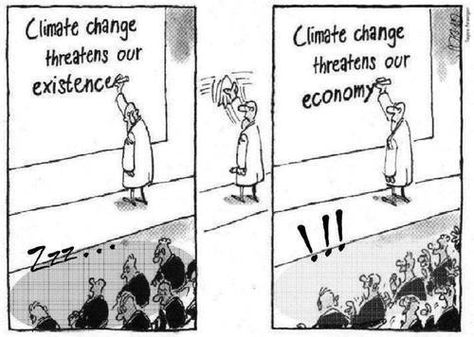
Though some people are still apparently unwilling to believe that climate change is real, or that humans are the major cause of it, these very real economic and biophysical costs are of increasing concern to global policymakers, public health professionals, the insurance industry, and even the military. And ironically it’s perhaps the risk to the economy, even more than to the biosphere, that will drive a meaningful response.

Continue reading “Sounding the Alarm”

Fighting Climate Change in Donald Trump’s America

Listening to Trump’s victory speech early Wednesday morning (and much of what he has said since then) has led many to wonder if the entire election campaign was a con, and we’re now going to see a new, more humane, Donald Trump as President. “Would the real Donald Trump stand up?” is a question several pundits have begun to ask. And in his first statement after the election, President Obama noted Trump’s “new tone,” and hoped it would continue.

Here’s a key excerpt from Trump’s speech:

I pledge to every citizen of our land that I will be President for all of Americans, and this is so important to me. For those who have chosen not to support me in the past, of which there were a few people, I’m reaching out to you for your guidance and your help so that we can work together and unify our great country.

Continue reading “Fighting Climate Change in Donald Trump’s America”

Global Climate Deal and the Missing Link

The climate deal fleshed out in Lima, Peru, is that all countries can set their own climate goals [1,2,3]. But will this be effective in preventing dangerous greenhouse gas emissions? Very unlikely, writes Delton Chen (Geo-Hydrologist, Civil Engineer):

deltonDuring the past 250 years of industrial and technological revolution, the primary catalyst for innovation and the fundamental driver of economic growth has been the availability of fossil fuels (i.e. coal, oil and gas). To avoid extremely dangerous climate change, the global economic system must be re-organised at a fundamental level, and the new order must include a social transformation that grows exponentially; otherwise the required mitigation of greenhouse gas (GHG) emissions will be too slow to avoid a climate catastrophe.

The United Nations Framework Convention on Climate Change (UNFCCC) was put into effect in 1994, and civilisation officially acknowledged that it was ‘addicted’ to fossil fuels. The ultimate aim of the UNFCCC is to prevent “…dangerous human interference with the climate system”[4]. The recent UNFCCC’s meeting in Lima, Peru, provides the latest update on civilisation’s de-carbonisation program, but the results of the Lima meeting signify global action will be further delayed given that nations are only obliged to make voluntary commitments. 

Continue reading “Global Climate Deal and the Missing Link”

Crowdfunding for PACE in New Jersey

JCloudStorerSmThe challenges we face in New Jersey as a result of climate change are significant, and so therefore are the opportunities. The experience of Superstorm Sandy showed us just how ill-prepared we are for the more frequent recurrence of extreme weather; and how important it is that we set an example for taking action to mitigate our own greenhouse gas emissions, as other states are doing around us. And there’s also no doubt about the urgency of it — as you can see from this remarkable video:
Continue reading “Crowdfunding for PACE in New Jersey”